
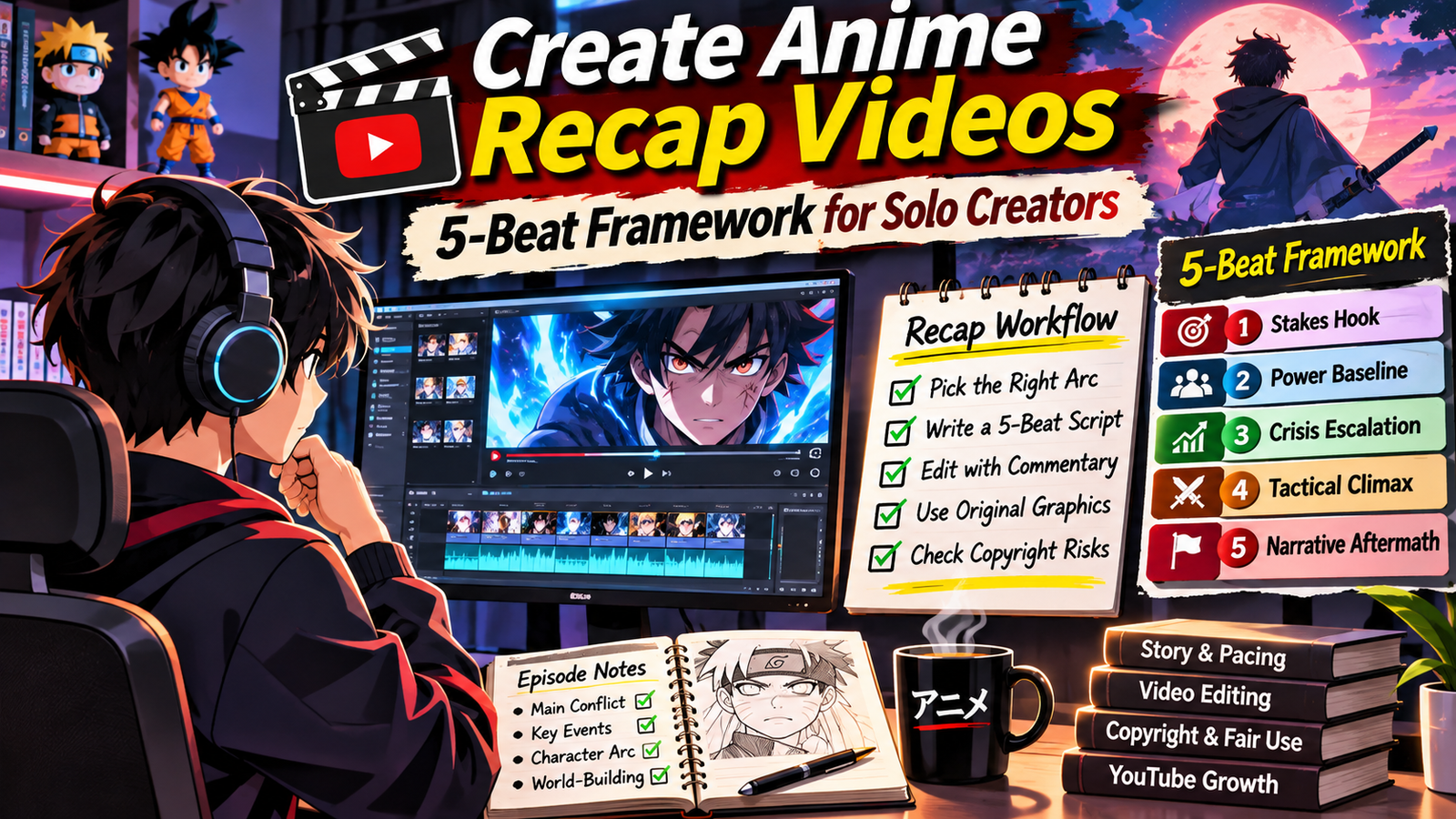
Publishing long-form anime recaps and character breakdowns on YouTube requires a far more disciplined workflow than basic television commentary. If you plan to create anime recap videos that retain audiences across 15 to 20 minutes, your presentation cannot rely on passive episode summaries. Viewers quickly leave when narration drags, visual presentation feels repetitive, or pacing stalls on minor plot exposition.
Building a sustainable anime channel when you create anime recap videos as a solo creator does not require advanced animation studios or insider access. What matters is a repeatable production pipeline built on structural story filtering, active transformative editing, custom audio design, and narrative pacing that keeps the audience hooked through key character stakes.
The objective is never to replace the original anime release. The purpose is to deliver an insightful, engaging breakdown that analyzes narrative tension, clarifies complex world-building, and offers fresh commentary.
Table of Contents
1. Episode Filtering: Selecting Arcs with Strong Search & Story Demand
New creators often try to summarize every single scene across an entire season. This approach creates bloated 40-minute scripts that overwhelm viewers with irrelevant filler.
To establish strong organic search and browse performance when you create anime recap videos, apply a three-stage story filter:
A. Audience Search Intent Mining
Before scripting, evaluate how audiences search for the series on YouTube and Google:
- Compare search terms such as
[Anime Name] power system explained,[Arc Name] recap and ending, andwhy did [Character] betray [Clan]. - Look for arcs where viewers frequently express confusion regarding character motives, power scaling, or complex timelines.
- Target specific narrative milestones rather than vague episode blocks to give your breakdown immediate relevance.
B. The Core Conflict Arc
Identify the primary emotional or physical dilemma driving the narrative arc. Discard subplots that do not directly alter the main protagonist’s trajectory or central conflict:
- Training sequences that introduce no new narrative consequences.
- Comedic filler sequences that stall the primary storyline.
- Minor character introductions that resolve within a single scene without affecting the main plot.
C. Contextual World-Building Over Literal Recaps
Audiences watch anime recaps to understand deep magic systems, political intrigue, or complex timelines. Focus your breakdown on rules and stakes that casual viewers might miss:
- Explain how power-scaling systems function and why a specific battle outcome matters.
- Highlight thematic foreshadowing embedded in background details.
- Contrast the protagonist’s mindset against the antagonist’s motivation rather than just listing attacks.
Before you create anime recap videos, organise your episode notes around the main conflict, character development, and story events that genuinely affect the arc. If you are expanding across broader video storytelling niches, reviewing our structural breakdown on how to script a true crime video can also give you deeper insights into pacing investigative arcs and mysterious reveals.
2. The 5-Beat Narrative Scripting Framework
Reading a chronological scene-by-scene script creates a monotonous delivery. When you create anime recap videos, use each narrative beat to explain a new development rather than simply repeating what viewers have already seen.
Structure your episode recap using a five-beat narrative outline:
Beat 1: The Stakes Hook (Approx. 0:00 – 1:30)
Skip generic channel welcomes and channel intro graphics. Open directly with the philosophical clash or life-threatening challenge.
Illustrative example (fictional scenario):
“Before the final barrier fell, the academy’s top strategist realized his entire defensive perimeter had been designed around a traitor within his own council.”
Hook the audience with an urgent situation before resetting to explain how the scenario developed.
Beat 2: Power Baseline (Approx. 1:30 – 4:00)
Establish what the protagonist is capable of at the start of the arc. Clarify their limitations, relationships, and current standing so subsequent battles carry measurable weight.
Beat 3: The Crisis Escalation (Approx. 4:00 – 9:00)
Explain where the established rules break down:
- What unexpected opponent or plot revelation disrupts the plan?
- Which moral compromise must the protagonist make to survive?
- Detail the psychological shift rather than describing every physical blow.
Beat 4: Tactical Climax (Approx. 9:00 – 15:00)
Break down the main battle or confrontation as an analytical breakdown rather than background noise. Explain the tactics, hidden techniques, and critical turning points that decide the outcome.
Beat 5: Narrative Aftermath (Approx. 15:00 – End)
Conclude with the unresolved questions, shifting power balances, and what the outcome signals for upcoming story arcs.
3. Visual Storytelling and Copyright Considerations
When editing an anime video essay, your visual track must support and illustrate your spoken commentary. It is critical to understand that editing adjustments (such as slight crops, color grading, or motion effects) are creative choices to improve pacing—they are not guaranteed legal shields against copyright claims.
YouTube’s Content ID system matches uploaded video content against visual and audio databases provided by copyright owners. Adding basic visual filters or cropping borders does not grant permission to use proprietary footage.
For creators dealing with software crashes or rendering bottlenecks during long-form video exports, our Creator Troubleshooting Database: 5,000+ Production Fixes provides direct hardware and encoder diagnostics.
A. Prioritize Original Explanatory Graphics
Rather than relying continuously on raw anime footage, build visual variety with original assets:
- Create custom relationship trees, character progression charts, and timeline graphics.
- Illustrate tactical abilities and energy rules using motion graphics or labeled layout diagrams.
- Use still frames or manga panel excerpts selectively to emphasize specific artistic choices, keeping in mind that still artwork also carries copyright ownership.
B. Context-Driven Visual Pacing
- Keep clips strictly trimmed to the exact moment referenced in your spoken commentary.
- Avoid letting continuous, unedited scenes play out where the viewer is essentially just watching the original show.
- Apply subtle camera motion (such as gentle slow pans or slight push-ins across still artwork) to give static compositions intentional visual texture.
4. Audio Architecture and Voiceover Delivery
A balanced audio mix is essential for viewer retention across long-form essays. However, separating or muting audio tracks is a production quality choice, not a legal loophole. Japanese animation dialogue and sound effects can also be protected recordings.
Vocal Processing and Ambient Beds
- Clean Dialogue Balancing: If a short line of spoken dialogue is necessary to illustrate a story point, lower or duck the underlying track so your voiceover remains the primary focus.
- Independent Background Music: Replace original soundtrack cues with properly licensed or royalty-free ambient music that fits the mood of your analysis. Keep your music track balanced around -22 dB to -26 dB beneath your primary voiceover.
- Vocal Equalization: Use a gentle high-pass filter around 80 Hz to remove low-end rumble and maintain clear speech definition throughout the breakdown.
To see how pacing, voiceover balance, and fair critique principles apply across other media listicles, explore our guide on how to create movie review videos.
5. Timeline Pacing Blueprint for 15-to-18-Minute Recaps
This timeline gives creators a practical structure to follow when they create anime recap videos for a longer YouTube format:
| Timeline Segment | Structural Purpose | Visual and Audio Technique |
|---|---|---|
| 0:00 – 1:30 | Opening Dilemma | Introduce the main conflict and stakes using focused narration and relevant visual anchors. |
| 1:30 – 4:00 | Power Baseline | Explain character abilities, limitations, relationships, and important world rules with clean graphic cards. |
| 4:00 – 9:00 | Crisis Escalation | Detail tactical maneuvers, unexpected betrayals, and shifting momentum using kinetic pans. |
| 9:00 – 15:00 | Tactical Climax | Analyze the main confrontation, tactical turning points, and pivotal decisions over muted beds. |
| 15:00 – End | Narrative Aftermath | Explain story implications, character growth, unresolved questions, and future arc setups. |
Avoid stuffing your timeline with unrelated reaction memes or jarring cartoon sound effects. An analytical, respectful tone keeps the viewer engaged in the story.
6. High-CTR Packaging: Curating Character Intrigue
Anime audiences are passionate and respond strongly to high-stakes thematic questions.
Title Framing
- Generic: “Sword Fighter Season 1 Full Recap”
- High-Intent: “How One Tactical Gamble Shattered the Academy’s Strongest Clan”
Specific conflict-driven titles communicate the video’s central story angle more clearly than broad catalogue labels, helping viewers understand what makes the recap distinctive.
Thumbnail Construction
- Focus on a single character expression highlighting severe concentration, betrayal, or quiet confidence.
- Isolate the subject from busy backgrounds using high-contrast lighting or soft edge separation.
- Keep thumbnail text strictly limited to two or three impactful words (e.g., “The Traitor” or “Zero Options”). Ensure the lower-right corner remains completely clear of text to prevent mobile duration timestamps from blocking your hook.
Frequently Asked Questions About Anime Recaps
How can solo creators reduce copyright risks when they create anime recap videos?
Start by understanding that there is no editing technique that guarantees an anime recap will avoid copyright claims. Cropping, mirroring, changing playback speed, adding filters, or removing the original soundtrack does not automatically grant legal permission to use copyrighted anime footage. Build your video around original narration, character analysis, story interpretation, and custom explanatory graphics. Use third-party anime clips or images only when you have permission, an appropriate licence, or a valid legal basis for the specific use under applicable copyright law. Keep each visual reference relevant to the point you are explaining rather than allowing long footage sequences to replace your own commentary. Remember that even short excerpts can result in copyright issues, as automated systems can identify matching audio and visual material.
Can anime recap channels be monetized on YouTube?
Yes, create anime recap videos channels may qualify for the YouTube Partner Program when their videos provide meaningful original commentary, distinctive analysis, or educational value under YouTube Channel Monetization Policies. However, adding simple narration or basic edits to anime footage does not automatically make a channel eligible. YouTube evaluates reused content separately from copyright enforcement, looking for significant original transformation. Even when a video offers substantial original commentary, copyright claims or advertising restrictions may still apply.
What is the ideal script length for a 15-minute anime recap?
A 15-minute anime recap script typically requires approximately 2,000 to 2,200 words when narration averages 135 to 145 words per minute. A script containing 2,400 words will generally run closer to 17 to 18 minutes of spoken narration. The actual final duration will also vary based on dialogue excerpts, deliberate pauses, and visual transition sequences.
Frequently Asked Questions About Creating Anime Recap Videos
How can solo creators reduce copyright risks when they create anime recap videos?
Start by understanding that no automated editing trick guarantees protection from copyright claims. Cropping, flipping footage, altering pitch, or muting original soundtracks does not grant legal reuse rights. Build your video around meaningful original narration, thematic analysis, and custom visual graphics. Use third-party footage strictly to support specific critique points rather than letting raw scenes run as a substitute for watching the original series.
Can anime recap channels be monetized through the YouTube Partner Program?
Yes, anime recap channels can qualify for monetization if their videos provide clear transformative value, original analytical commentary, or educational breakdown. Channels that simply publish automated voiceovers over unedited episode clips risk being rejected or demonetized under YouTube’s reused content policy.
What is the ideal script word count for a 15-minute anime recap?
A standard 15-minute anime recap typically requires between 2,000 and 2,200 words at a deliberate speaking pace of 135 to 145 words per minute. Including 2,400 words usually extends narration closer to 17 or 18 minutes, depending on pauses, dialogue quotes, and visual pacing.